


What Exactly is a Mobile Robot Scheduling System Scheduling?
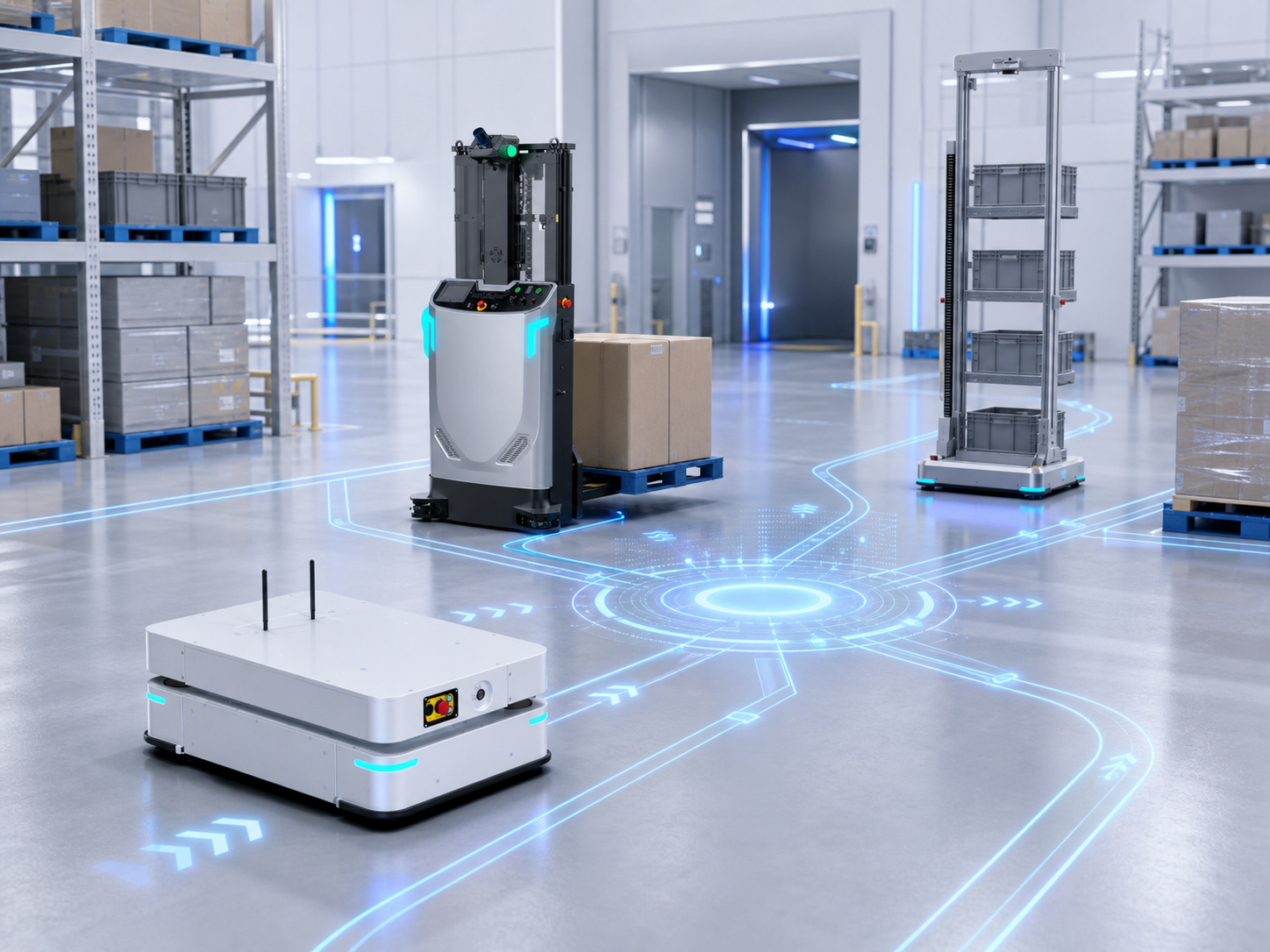
In mobile robot projects, the robots themselves are always the most visible element: Can they run properly? Can they avoid obstacles? Can they deliver goods to their destinations?
However, what truly determines whether a project can operate reliably in the long run is usually not an individual robot, but the scheduling system behind the scenes.
Getting a single vehicle from Point A to Point B is a navigation problem. Having dozens or hundreds of vehicles concurrently receiving tasks, competing for rights-of-way, waiting for elevators, picking and placing goods, charging, detouring, and recovering from exceptions within the same facility—that is the problem a scheduling system is built to solve.
Therefore, the essence of a mobile robot scheduling system is not just "assigning an order to a vehicle," but enabling a fleet of robots to collaborate efficiently around business processes.
In the industry, it goes by many names: Robot Control System (RCS), Fleet Management System (FMS), Group Control System, or AMR/AGV Fleet Management System. While the nomenclature varies, the core objective remains the same: to seamlessly connect robots, tasks, maps, peripheral equipment, and upper-level business systems.
Generation 1: Keeping Vehicles from "Fighting"
In the early days of scheduling systems, the paramount objective was safe traffic control.
When multiple vehicles operate on the same map, the biggest risks are gridlock, deadlocks, mutual waiting, and head-on standoffs. Consequently, first-generation scheduling functioned more like a traffic management system, relying on rules such as one-way lanes, two-way lanes, exclusion zones, intersection avoidance, and queuing to keep vehicles running along predetermined routes.
The advantage of this type of system is its clear rules, making it well-suited for AGV projects with few vehicles, fixed paths, and static business logic.
However, its limitations are obvious: it primarily focuses on "managing vehicles" rather than "optimizing business operations." As the fleet size grows, routes become more complex, and tasks change in real-time, relying solely on exclusion zones and manual rules easily leads to congestion and idle waiting.
Generation 2: Moving from Traffic Control to Order Assignment
Later on, scheduling systems began evolving from "traffic control" to "task scheduling."
The system no longer just judged whether a path was clear, but also had to determine: Which vehicle is best suited to take this specific task?
For instance:
- Which vehicle is closest?
- Which vehicle has sufficient battery?
- Which vehicle is currently idle?
- Which task has a higher priority?
- When is the optimal time to charge?
- Can a vehicle pick up an extra box or deliver an extra order along the way?
At this stage, scheduling systems began to truly integrate with on-site business operations. They could interface with upper-level systems like WMS, MES, and ERP, supporting features such as task prioritization, multi-point pick-and-place, basic batching (order pooling), equipment integration, and status monitoring.
Yet, new challenges emerged. Real-world projects rarely offer textbook scenarios.
Warehousing, production lines, and distribution all have distinct business logic. Different carriers—such as pallets, racks, and bins—require different scheduling strategies. Furthermore, the system must interface with on-site equipment like elevators, automatic doors, lifters, roller conveyors, machines, and PLCs. The more complex the customer's requirements, the quicker fixed rules fall short.
Generation 3: Scheduling Systems that "Understand Business"
Advanced scheduling systems today no longer just answer "how the vehicle should move." Instead, they provide a comprehensive solution to:
- How should tasks be decomposed?
- Who should execute them?
- When should they be executed?
- Which route should be taken?
- How should conflicts be resolved?
- How should peripheral equipment be coordinated?
- How can the system recover from exceptions?
- How can it scale as business requirements change?
This represents the core shift of third-generation scheduling systems: moving from "dispatching vehicles" to "orchestrating business workflows."
A critical technological frontier driving this shift is MAPF (Multi-Agent Path Finding).
Traditional path planning focuses on finding the shortest path for a single vehicle. However, in a multi-robot system, the fastest route for one vehicle does not equate to the highest efficiency for the entire fleet. A single vehicle taking a shortcut might end up blocking ten others behind it.
MAPF focuses on global coordination among multiple robots within a shared space. It ensures they operate with minimal conflict, waiting, and deadlocks, while planning executable paths within acceptable computation times (Global Optimization).
This is why a scheduling system cannot be evaluated solely on single-point algorithmic metrics. The real difficulty lies in striking a balance among efficiency, stability, computational speed, and practical execution on-site.
A Great Scheduling System is Becoming the "On-Site Operations Nerve Center"
Modern scheduling systems are no longer standalone modules; they are comprehensive platforms.
They must connect to business software to receive tasks from WMS, MES, ERP, or upper-level systems; handle task orchestration, including task decomposition, prioritization, and workflow control; make scheduling decisions regarding order dispatching, bidding, reassignment, batching, and charging strategies; and manage path planning, traffic control, equipment integration, operational monitoring, and exception recovery.
Going a step further, simulation capabilities have become essential. Before a project goes live, can the system simulate real-world order volumes? Can it detect traffic bottlenecks in advance? Can it validate whether the robot count, path planning, and equipment cycle times are optimal? These factors directly dictate project delivery quality.
Thus, scheduling systems are transforming from "robot traffic management tools" into the operational nerve center of mobile robot projects.
What M4 Resolves are Real-World Scheduling Challenges in Complex Environments
M4 is an intelligent robot scheduling system built by SEER for mobile robot projects. Rather than focusing solely on single-vehicle path planning, it is designed around multi-robot collaboration, business adaptation, equipment integration, and long-term stability in real-world deployments.
A defining feature of M4 is its powerful business adaptability. It supports diverse scenarios including warehousing and distribution, accommodates various carriers like pallets, racks, and boxes, and handles multi-zone, mixed-fleet operations alongside complex on-site equipment. M4 provides comprehensive out-of-the-box integration for common equipment such as automatic doors, elevators, lifters, weighing scales, vision-guided systems, roller conveyors, and machinery.
On the algorithmic front, M4 features multiple built-in algorithms for order dispatching, path planning, and traffic control that can be dynamically switched based on scenario characteristics. It also incorporates proprietary MAPF algorithms to maximize multi-robot collaborative efficiency while minimizing conflicts, congestion, and deadlocks.
In terms of engineering capabilities, M4 supports advanced task management features like dynamic dispatching, task bidding, transport order reassignment, dynamic batching, on-the-fly pooling, and mixed pick-and-place workflows. It also delivers robust reliability features, including automatic recovery after downtime, operational recording and playback, real-time heatmaps, unified error handling, and comprehensive HTTP APIs and callbacks.
For highly complex projects, M4 provides script-based extensibility. Users can leverage Python or JavaScript to customize dispatching strategies, docking rules, charging policies, location management, alert routing, and third-party equipment interfaces. This architecture ensures that standard features cover the vast majority of scenarios, while scripting capabilities seamlessly absorb non-standard, site-specific demands.
The value of these capabilities becomes evident as project complexity rises: a scheduling system cannot just be "functional"—it must be explainable, adjustable, extensible, and resilient.
Ultimately, Evaluating a Scheduling System Goes Beyond "Smartness"
Many customers ask: Is this scheduling system smart enough?
However, "intelligence" is not a single capability. It encompasses both algorithmic prowess and deep business comprehension; it requires functional completeness as well as ease of use; it demands high efficiency alongside rock-solid stability; and it balances standardization with extensibility.
The ultimate benchmark for a mobile robot project is not how flashy the robots look in a demo video, but whether the system can run stably on-site over the long haul.
A great scheduling system should allow robots to seamlessly blend into an enterprise’s business workflows—ensuring tasks are successfully received, paths are cleared, equipment is connected, exceptions are recovered, and the system easily scales as the business evolves.
This is the exact direction in which the M4 scheduling system continues to evolve.
