


What is M4: Why Robotics Projects Require an "All-in-One" Dispatch and Business Management System
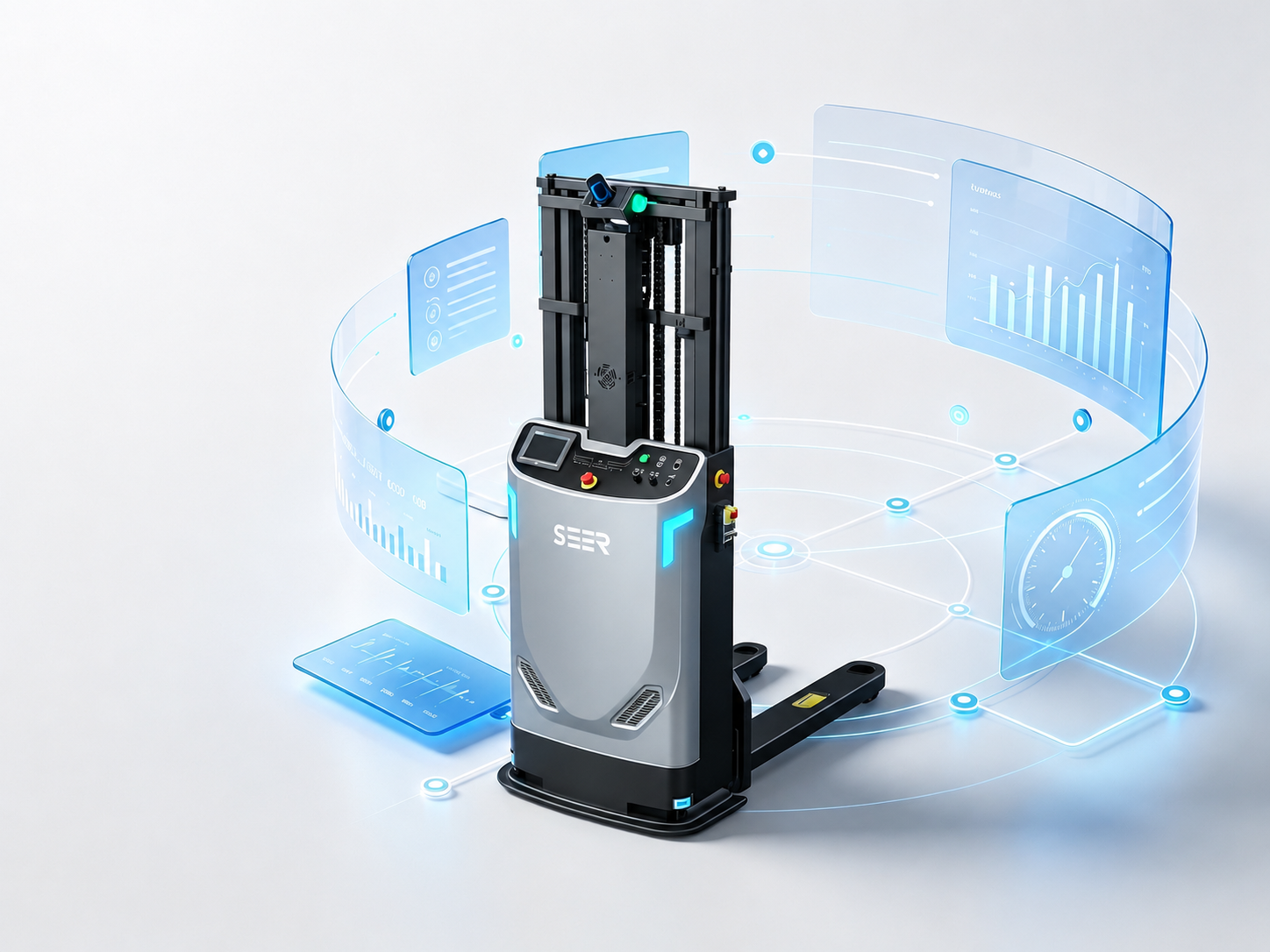
In many robotics projects, initial focus typically centers on straightforward questions: Can the vehicle move? Can it get from Point A to Point B? Can it avoid obstacles? Can it complete transport tasks along a designated route?
However, once a project goes live, real-world site bottlenecks often extend far beyond whether a vehicle can navigate. Robots need to know which tasks to accept, what cargo to carry, where to pick it up, where to deliver it, and when to prioritize it. They must also know how to handle doors and elevators, who gets the right-of-way during traffic congestion, and how to recover when anomalies occur. In other words, a robotics project is not merely a "navigation problem"; it is a systemic challenge composed of tasks, vehicles, maps, peripheral equipment, inventory, human operations, and operational tact times.
The core problem M4 addresses is unifying robotic dispatching capabilities and business management workflows within a single system architecture. This ensures that robots do not just "move," but seamlessly and reliably integrate into real-world business processes.
Robotics Projects Are About More Than Just Making Vehicles Move
During the pilot phase, getting a single robot to complete a transport task along a designated route is relatively simple. The true challenge arises when the site involves multiple robots, various vehicle types, diverse workflows, and heterogeneous equipment operating concurrently. Under these conditions, the system must remain stable, orderly, and resilient.
For instance, a single warehouse might simultaneously deploy Automated Guided Vehicles for racking, Autonomous Mobile Robots for multi-tote handling, and automated forklifts for pallet storage and retrieval. Each type varies in chassis dimensions, turning radii, payload capacities, and aisle constraints. Even if they appear to simply move from one point to another on a digital map, their underlying business contexts are fundamentally different.
Real-world operations introduce numerous variables. Robots may need to operate across multiple floors, requiring them to interface with elevators. They may need to pass through automatic doors, requiring the system to open the doors in advance and close them after passage. They might encounter low battery levels, necessitating automated charging and docking. Furthermore, they can slip into anomalous states due to physical obstructions, network disconnections, or task errors. In M4’s dispatch documentation, operational scenarios intrinsically encompass not just individual robots, but robot groups, multi-zone layouts, doors, elevators, container types, and order dispatching strategies. This demonstrates that from the ground up, the dispatch target is the entire operational environment, not isolated vehicles.
Consequently, evaluating the maturity of a robotics project goes beyond single-vehicle navigation metrics. More importantly, the system must address critical operational questions: Where do tasks originate? How are they assigned to the right robot? How do robots manage conflict resolution and collaboration? How do peripheral devices interface with the fleet? How are anomalies exposed and recovered? How do operators visualize the real-time status of the facility?
If these functions are fragmented across disparate systems, it creates operational silos: the business system knows what to move, the dispatch system knows where the vehicle is, and the device control system knows the status of doors and elevators. Yet, no single unified platform exists to determine how the current workflow should be executed end-to-end.
The Distinct Roles of Dispatch Systems vs. Business Systems
Dispatch systems solve the problem of how robots execute tasks. They monitor whether robots are online, available for orders, and under control. They govern path planning, traffic control, spatial resource allocation, obstacle avoidance, re-routing, and anomaly recovery. For a dispatch system, the core objective is to ensure that multiple robots operate safely, orderly, and efficiently within a shared environment.
Business systems solve the problems of where tasks originate, what those tasks signify, and at what stage of execution they stand. They manage transport orders, operational steps, containers, storage locations, priorities, status updates, exception handling, and audit trails. For a business system, the core objective is to provide site personnel and upper-level systems with clear, transparent management of the entire operational workflow.
Take a "Transport Order" as an example. It is not just a simple navigation command; it is the core business object of the dispatch system, representing a complete "move robot from A to B" assignment. A transport order contains information on the assigned executor, cargo details, destination, urgency level, and real-time status. As explicitly stated in the documentation, transport orders serve as the bridge between upper-level business logic and bottom-layer robotics. The dispatch system handles robot selection, path planning, traffic control, and exception handling.
This is precisely why robotics projects cannot rely solely on low-level controllers or standalone path-planning engines. A low-level controller can execute physical actions but lacks visibility into business priorities. A path planner can compute an optimal route but cannot verify whether the cargo has been successfully picked up. A device controller can open a door but does not know which robot is passing through or if another robot is queuing up next.
While dispatch and business systems have distinct boundaries, they must tightly collaborate in real-world deployments. The business system must translate operational tasks into transport orders and discrete steps that robots can execute. Meanwhile, the dispatch system must assign tasks to the appropriate robots based on real-time site conditions while continuously managing paths, right-of-ways, equipment interfaces, and anomalies.
When these two systems are decoupled, sites often suffer from the "capable vehicles, broken workflows" dilemma. For instance, a task might be executed, but the business system remains unaware of its completion. A robot might fault out, but operators are left in the dark about whether to cancel, retry, or intervene manually. Or an upper-level system might issue a task that fails to execute reliably because the dispatch side lacks critical constraints regarding containers, vehicle models, or routing rules.
Why an All-in-One Architecture Suits Complex Operational Sites
Complex environments are ill-suited for highly fragmented dispatch and business architectures. While decoupling is technically feasible, it incurs prohibitive integration overhead, communication latency, and exception-handling costs.
A case in point is multi-zone or multi-scenario deployments. Historically, if two facility zones had vastly different requirements, teams would deploy two separate dispatch systems. However, this introduces severe bottlenecks: if storage locations, materials, and inventory require unified management—or if the site demands a one-click startup/shutdown or a system-wide emergency stop ParseError: KaTeX parse error: Undefined control sequence: \- at position 2: E\̲-̲stop—disparate dispatch instances make unified control nearly impossible. M4 documentation notes that a single M4 dispatch system supports the concurrent execution of one or multiple scenarios. This design choice goes beyond saving server resources; it maintains a unified management perspective across complex projects.
The value of an All-in-One architecture is realized across four pillars:
-
Unified Objects: Robots, robot groups, maps, zones, doors, elevators, container types, transport orders, and strategies are all managed within a single system. The operational site is treated as an interconnected ecosystem of related objects rather than a collection of isolated modules.
-
Unified Statuses: Knowing whether a robot is online, ready, or controlled; whether a transport order is pending, executing, completed, canceling, faulted, or suspended; and whether equipment is online or occupied—all of this must be readily accessible. If these statuses are scattered, troubleshooting bottlenecks becomes incredibly difficult. A unified system ensures users can observe, filter, locate, and resolve issues within a single, cohesive context.
-
Unified Strategies: Order dispatching, traffic control, opportunity charging, staging, and equipment integration strategies inherently dictate overall site efficiency. If controlled by separate systems, localized optimization often leads to global inefficiency. For example, a specific path might be optimal for a single vehicle, but if that route gridlocks a main thoroughfare, delays elevator queues, or blocks a critical workstation, it becomes highly inefficient for the entire operation.
-
Unified Exception Handling: Once a robotics project goes live, the bulk of an engineering team’s energy is spent managing edge cases and exceptions rather than standard workflows. What happens if a vehicle drops offline? What if a task fails? What if a cancel command is issued after cargo pickup? What if there is an equipment reservation conflict? In an All-in-One system, an anomaly is not just an isolated technical error log; it is mapped directly back to its corresponding task, robot, operational step, and business object for contextual resolution.
All-in-One does not imply that every project must utilize every feature on day one. Instead, it serves as a unified foundation: simple projects can leverage only basic dispatching and transport order capabilities, while complex deployments can seamlessly scale to include multi-model fleets, multi-zone layouts, doors, elevators, automated charging, simulation, and AI-powered diagnostics. Crucially, the system does not need to be ripped out and replaced as operational complexity scales.
Typical Deployment Scenarios for M4
M4 is ideally suited for projects where robots are deeply embedded within business workflows rather than running in isolation:
-
Heterogeneous Fleet ParseError: KaTeX parse error: Undefined control sequence: \- at position 6: Multi\̲-̲Model Co-Dispatching: Deployments where forklifts, AMRs, and AGVs handle different tasks within the same environment. Different models imply distinct material handling mechanisms, kinematic/collision models, map constraints, and load/unload logic. The system cannot simply dispatch the "nearest vehicle"; it must evaluate vehicle capabilities, task attributes, aisle constraints, and real-time site resources.
-
Multi-Zone and Multi-Floor Operations: Scenarios requiring cross-floor logistics or containing multiple independent operational zones. M4’s scenario and zone models accurately map different zones, distinct robot group maps, and cross-zone routing relationships. As noted in the dispatch tutorials, a scenario can span multiple zones, allowing robots to execute cross-zone operations, such as changing floors.
-
Peripheral Equipment Integration: Environments where automatic doors, elevators, and charging stations are critical dependencies for continuous operation rather than afterthought add-ons. In M4, once doors and elevators are configured, the system automatically identifies tasks requiring these assets, managing door opening/closing and elevator calling/interfacing seamlessly to transport robots across boundaries.
-
High-Density, Tact-Time-Sensitive Workflows: High-throughput environments prone to congestion, queuing, deadlocks, and task bottlenecks. Here, simple path planning is insufficient; the site requires robust traffic control, spatial resource management, task serialization, automated exception retries, and operational analytics.
-
Simulation Validation and Continuous Optimization: Environments where site trial-and-error is too costly or disruptive. M4 supports one-click simulation to generate virtual robots, doors, and elevators. This allows project teams to validate task execution, path planning, and equipment integration before physical assets arrive on site.
-
Customized Business Workflows: Enterprises with unique operational flows—whether focused on production line replenishment, warehouse logistics, inventory and container rotation, or workstation tact times. M4's value lies in linking robotic tasks with business objects, task templates, operator UIs, and exception management, aligning the robotic fleet with actual enterprise processes.
From this perspective, M4 is far more than a fleet management tool—it is a comprehensive dispatch and business management system purpose-built for robotics deployment sites. It simultaneously understands vehicles, tasks, maps, peripheral equipment, and business outcomes.
