


From Single Vehicles to the Entire Site: Understanding M4’s Three-Tier Configuration Architecture
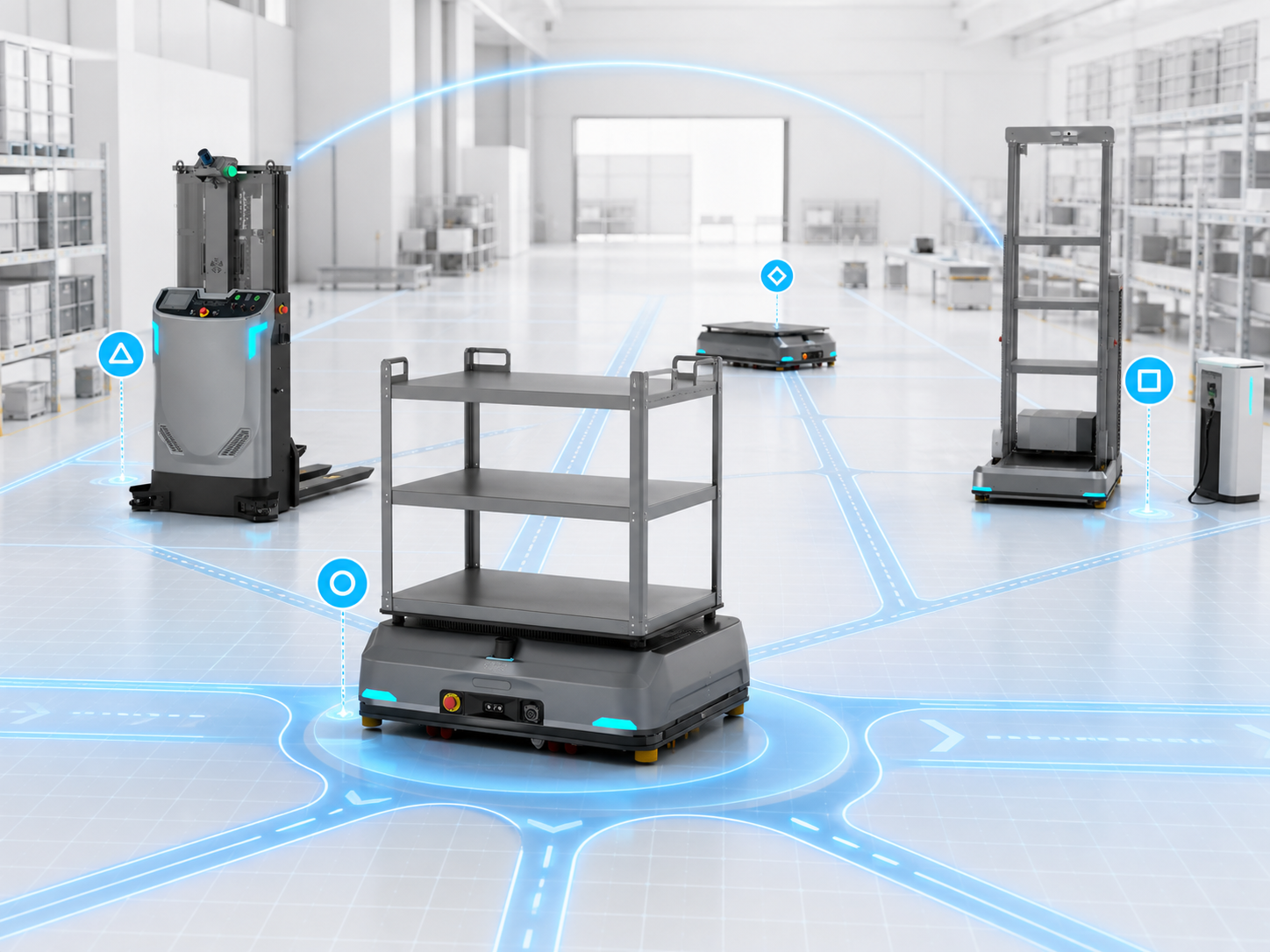
M4 configuration is the process of translating robot models, individual vehicle data, and site management requirements into executable system rules. The relationship among these three tiers can be summarized as: Scene Configuration governs the entire site, Robot Group Configuration manages a specific category of robots, and Robot Configuration controls an individual robot.
Robot Group configuration tells M4 "what this type of robot can do"; Robot configuration tells M4 "which specific vehicle it is"; and Scene configuration determines "under what rules the entire site collaborates". Only when all three tiers are configured accurately do core functions—such as task assignment, traffic control, and automated charging—have a reliable operational foundation.
Robot Group Configuration: Unified Management of Shared Capabilities
A single project may simultaneously deploy various vehicle types, such as latent lifter AMRs, forklifts, and autonomous case-handling robots . Because their physical dimensions, motion dynamics, and operational capabilities differ, they must be managed separately through Robot Groups.
In M4, different robot types must be categorized into distinct Robot Groups. Vehicles of the same model can also be further grouped based on business lines or operational units. An individual robot can belong to only one Robot Group at a time.
Robot Group configuration primarily defines the shared characteristics of a specific robot type, including:
-
Safety margins and motion parameters;
-
Whether cargo can rotate and whether payload extends beyond the chassis footprint;
-
Vehicle-specific operational rules ;
-
Speed profiles, collision models, and battery consumption rules for simulated robots.
These parameters directly participate in path planning, collision detection, and action execution. Note that for real robots, collision models are reported in real-time by the vehicle onboard systems and read directly by M4, rather than being manually set in standard Robot Groups. Collision models for simulated robots, however, must be configured separately within a Simulation Robot Group.
The value of the Robot Group lies in centralizing the maintenance of shared rules. When scaling up identical robots, there is no need to duplicate full capability profiles for each vehicle, ensuring streamlined and consistent adjustments over time.
Robot Configuration: Enabling Accurate Identification and Connectivity
While a Robot Group defines a category of vehicles, Robot Configuration maps to a specific physical vehicle on site.
The robot name serves as a vital unique identifier within M4 and must remain unique across the system. Once created, a robot must be configured with its designated Robot Group, connectivity method, maximum payload capacity, and other essential attributes. For multiple vehicles with standardized naming conventions, M4 supports batch creation using name prefixes, digit lengths, and numerical ranges, significantly reducing manual input efforts.
When using simulated robots, initial parameters such as starting nodes, orientations, and initial battery levels can be configured to validate system performance under low-battery charging triggers, error states, or varied starting locations.
Inaccurate Robot Configuration typically leads to the following issues:
-
Failure to establish a proper connection between the robot and M4;
-
Misallocation to an incorrect group, causing the vehicle to inherit inapplicable operational rules;
-
Discrepancies between configured maximum payload capacity and physical hardware constraints;
-
Name mismatches between system configurations and physical vehicle IDs;
-
Significant deviations between simulation outcomes and real-world vehicle performance.
Therefore, adding a new robot involves more than simply entering a name into the system; it requires verifying who the vehicle is, which group it belongs to, how it connects, and what load it can handle.
Scene Configuration: Governing Site-Wide Dispatching and Coordination
While Robot Group and Robot configurations address "who executes the task," Scene Configuration manages the universal operational rules for the entire site.
In M4, Scene Configuration governs core system behaviors, including dispatching strategies, traffic control, rerouting, deadlock resolution, auto-charging, and auto-parking. For instance, scene-level rules determine how the system selects an executor when multiple robots compete for a task, whether a robot should hold position or reroute when blocked ahead, and at what state-of-charge threshold a robot should initiate auto-charging.
Many parameters within Scene Configuration come pre-configured with default values. For standard projects, frequently tweaking advanced parameters merely to chase speed optimization is generally unnecessary. These parameters are highly interdependent: relaxing a constraint to boost localized throughput may inadvertently increase the risk of congestion, waiting times, or system exceptions elsewhere.
If adjustments are required, first identify the specific operational issue on site, then validate changes through simulation and test transport orders. Validation must go beyond confirming successful order creation—it must verify that the robot can accept the dispatch, execute all sub-steps, and reach the correct final state.
End-to-End Execution: How a Line-Side Delivery Task Traverses the Three Tiers
Consider a typical manufacturing workshop: 6 latent lifter AMRs are deployed to transport material racks from a staging area to the production line.
Step 1: Robot Group Configuration Defines Capability
During project commissioning, a "Latent Lifter Group" is established in M4 to unify safety margins, motion speeds, cargo rotation rules, and lifter-specific handling logic.
This tells M4 which shared operational rules this class of vehicles must follow and what tasks they are qualified to perform. When the production line triggers a rack transport request, it can explicitly designate the task to the "Latent Lifter Group," preventing other vehicle types from being inadvertently selected.
Step 2: Robot Configuration Assigns the Executor
Next, vehicles T-01 through T-06 are added to the "Latent Lifter Group," each configured with a unique name, connectivity profile, and maximum payload capacity. Once connected to M4, the system maps real-time status—including online availability, battery level, dispatch state, and fault alarms—to the specific physical unit.
At 10:00 AM, a transport order is generated by the production line. At this moment:
-
T-01 is busy with another task;
-
T-02 has hit its low-battery threshold and requires charging;
-
T-03 is offline;
-
T-04 through T-06 are online and available.
M4 filters out unavailable units and assigns the task to T-04 from the pool of ready vehicles.
Step 3: Scene Configuration Coordinates Fleet Execution
Once T-04 accepts the order, Scene Configuration actively manages the execution process:
-
Dispatching strategies determine optimal assignment;
-
Traffic control rules coordinate rights-of-way between T-04 and intersecting vehicles;
-
If blocked by a faulted or delayed vehicle ahead, rerouting and replanning rules evaluate whether T-04 should wait or calculate an alternative path.
Simultaneously, T-02 navigates to a charging station in accordance with scene-level auto-charging rules, preventing it from accepting new material handling tasks while low on power.
Ultimately, T-04 arrives at the staging point, picks up the rack, transfers it to the production line, and unloads it at the target destination. Only when all sub-steps are completed and the transport order transitions to "Finished" is the delivery task truly complete.
In this scenario:
-
Robot Group Configuration determines what this vehicle class can do;
-
Robot Configuration determines which specific unit executes it;
-
Scene Configuration determines how all vehicles collaborate.
Working in unison, these three tiers enable M4 to transform a raw material transport request into a safe, executable, and fully completed site task.
Precise Configuration Unlocks Robot Performance
A robot’s ability to navigate and transport goods does not automatically guarantee stable collaboration in complex operational environments. M4 relies on accurate configurations to comprehend the shared capabilities of each vehicle class, the distinct identity of each physical unit, and the overall operational rules of the site.
-
Robot Group Configuration eliminates redundant maintenance across similar vehicles;
-
Robot Configuration ensures precise identification and control of every individual unit;
-
Scene Configuration aligns the entire fleet under unified operational strategies.
Together, these three tiers form the foundation of M4’s fleet scheduling and routing engine, directly influencing the scalability, adaptability, and long-term maintainability of any mobile robot project.
