


Introduction to Smart Forklifts: From Manual Driving to Autonomous Operation
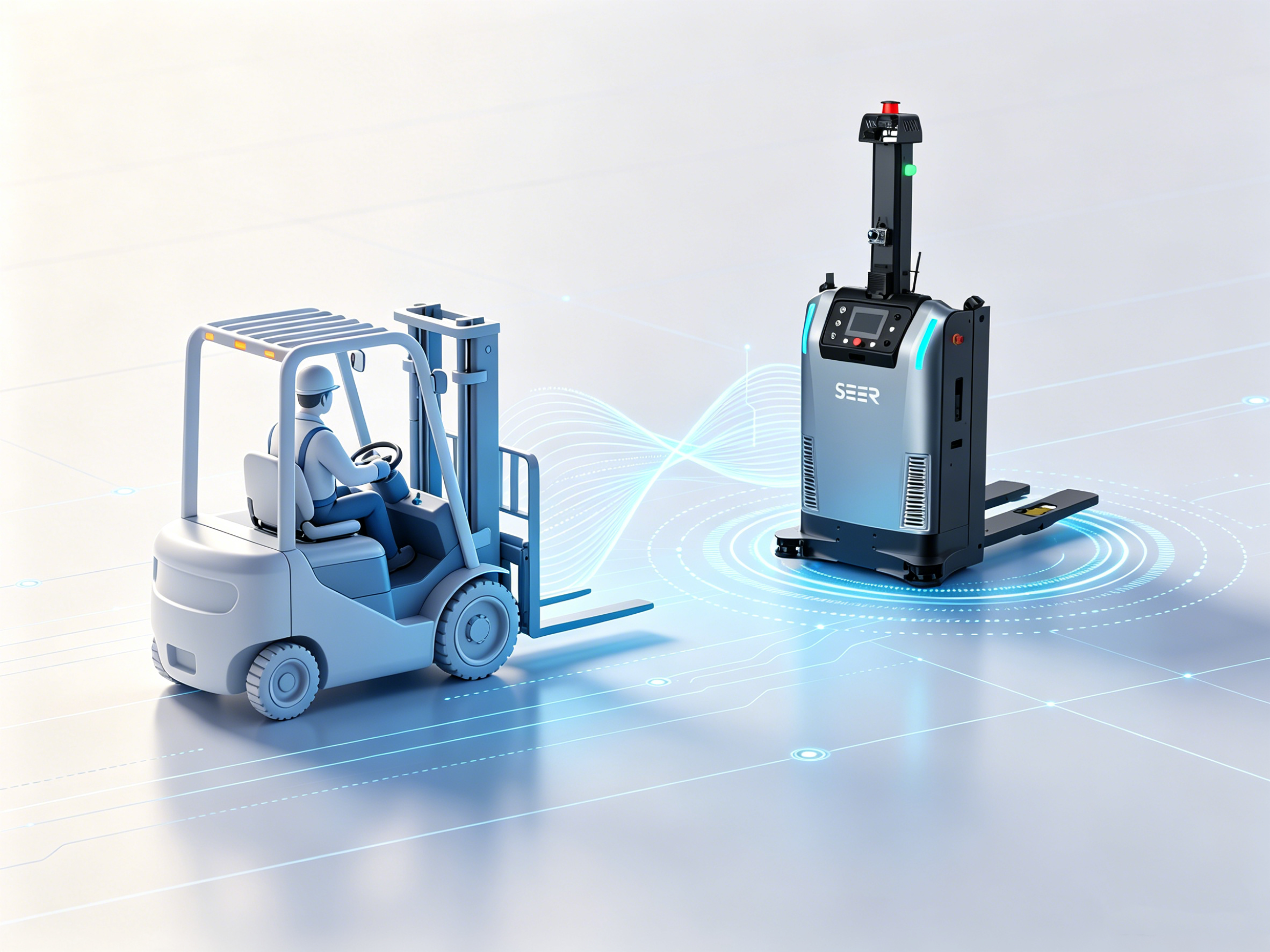
In the warehousing and logistics industries, forklifts are among the most ubiquitous material handling equipment. As the wave of intelligent transformation sweeps through manufacturing and warehousing, forklifts are undergoing a profound evolution—shifting from manual operation to smart robots under the unified command of a dispatching system, autonomously completing storage and retrieval tasks. Various forklift products from SEER are active participants in this transformation. How do smart forklifts work? What are their advantages and limitations compared to manual driving? And where will this transformation ultimately lead? This article starts with the fundamental concepts of forklifts to give you a comprehensive understanding of smart forklifts.
What Are the Different Types of Forklifts?
Before we dive into automation, let's look at the forklifts themselves. The forklifts we see on a daily basis can generally be divided into two categories.
The first category is pallet jacks, also known as horizontal movers. The forks have only two states—raised and lowered—and, and are designed specifically for horizontal transport on the ground. They tow pallets from one location to another without interfacing with racking systems. The structure is simple, and the application scenarios are straightforward.
The second category is pallet stackers . The forks can be raised and lowered to various heights, allowing them to deposit goods onto the second, third, or even higher tiers of a racking system. It is precisely this vertical lifting capability that makes the operational logic of pallet stackers much more complex—it requires precise control over the fork height at different stages to ensure both safety and efficiency.
This article focuses primarily on the intelligence and automation of these pallet stackers.
When a Human Drives a Forklift, What Are They Actually "Driving"?
To understand smart forklifts, we must first understand what manual operation actually entails.
When a skilled forklift driver executes a storage or retrieval task, they do far more than just "drive the vehicle over and pick up the cargo." They are constantly making judgments: Is the cargo aligned properly? At what angle should the forks enter? Where should this load go next, and which route is the smoothest? Someone is walking ahead—should I stop or bypass them? This tier of the rack is full—should I switch to another one?
Most of these judgments are made within seconds, often subconsciously. They rely on experience, spatial awareness, an overall perception of the environment, and real-time communication and collaboration with colleagues.
This is precisely the hardest part for smart forklifts to replicate at present.
After Machines Take Over, What Becomes Easier and What Becomes Harder?
Smart forklifts are managed under the unified command of a dispatching/fleet management system. The system knows the exact location of every forklift, the status of every storage location, and which vehicle should be assigned the next task. This information is updated in real time and is globally visible within the system, independent of any individual's memory or judgment.
This unlocks several capabilities that are difficult to achieve under a manual model.
-
scalable coordination. A single dispatching system can simultaneously manage dozens or even hundreds of forklifts, uniformly planning routes, allocating tasks, and coordinating traffic flow without any confusion over "who reports to whom."
-
high behavioral consistency. Human operational precision drops when drivers are fatigued or having an off day. Smart forklifts execute every storage and retrieval movement according to identical parameters. Fork height, insertion angle, and stopping positions always remain within the system's predefined thresholds, eliminating "poor performance."
-
continuous, 24/7 operation. No shifts, no lunch breaks, no holidays. In scenarios requiring high-intensity, continuous operations, this represents a structural advantage.
-
complete traceability. Every single movement is logged. If an issue arises, it can be traced back; operational data can be analyzed, allowing managers to see what actually happened rather than relying on verbal reports.
At the same time, however, certain things do become harder.
Smart forklifts rely on sensors and algorithms to perceive their environment. Sensors have blind spots, and perception can fail under exceptional circumstances—such as severe pallet misalignment, obstructed cargo, or temporary obstacles not marked on the map. When encountering these situations, machines cannot make rapid adjustments the way humans do; they often have to come to a halt and wait for manual intervention.
There is also a more fundamental limitation: current dispatching systems issue instructions to forklifts as segmented paths. The forklift itself does not see the full picture of the operation. This means it cannot make global anticipations like an experienced driver—such as sensing ahead of time that a certain aisle is about to become congested or that a specific storage location is particularly busy today, and adjusting accordingly. While machines are highly precise at the execution level, they still have a way to go when it comes to "reading the room."
Are Smart Forklifts Worth the Investment?
The answer to this question varies depending on the specific scenario.
If a warehouse's tasks are highly repetitive, structured, and demand long, continuous operational hours, smart forklifts can deliver significant efficiency gains and cost optimization. The logic holds up perfectly: free humans from repetitive physical labor so they can focus on work that requires higher-level judgment, while using machines to guarantee stability and traceability at the execution layer.
However, if the environment is highly complex, anomalies occur frequently, and the variety of goods is diverse and unpredictable, the operational scope for smart forklifts becomes limited, while demanding much higher system configuration and maintenance overhead.
The reality is that most warehouses fall somewhere in between. Automation is not a binary "plug-and-play" switch; rather, it is a journey of continuous tuning and optimization.
Where Will the Future Lead?
The current limitations of smart forklifts are largely limitations of perception and decision-making capabilities. As visual recognition, AI reasoning, and multi-agent coordination algorithms continue to advance, machines will become increasingly adept at "reading the room." They will develop a higher tolerance for cargo misalignment, faster response times to unexpected situations, and more holistic planning for complex tasks.
